China Great Green Wall: The China Great Green Wall is one of the boldest environmental efforts the world has ever seen. Picture this: tens of billions of trees planted across vast stretches of land, forming a living barrier between people and the advancing deserts of northern China. It is not a sci-fi idea or a government slogan. It is already happening on the ground, and the impact is both visible and powerful.
What makes the China Great Green Wall so important is not just the size of the project but the purpose behind it. As desertification continues to threaten livelihoods, agriculture, and even air quality, China is taking a stand with trees. This article dives into the details of this massive effort, explores how it is working, where it is struggling, and why it matters now more than ever. Whether you are curious about reforestation, climate change, or environmental innovation, there is something here for you.
China Great Green Wall: Turning Sand into Forest, One Tree at a Time
At the heart of the China Great Green Wall is a simple but ambitious idea—plant trees to push back the desert. Started in the late 1970s, the project covers thousands of kilometers across northern China, from the far western regions to the northeast. The goal is to slow the Gobi Desert’s advance and protect communities from frequent sandstorms. Instead of a single line of forest, it is a network of green zones: forests, shrubs, and grasslands built strategically across vulnerable landscapes.
Today, thanks to ongoing support from communities, farmers, schools, and government teams, the green wall is showing results. Forest coverage has increased in many regions. Sandstorms that used to hit cities like Beijing regularly are now less intense and less frequent. But the success is not just measured in trees. It is in the stories of villagers who now grow seedlings, run nurseries, or live in cleaner air. This is not only a fight against sand—it is a movement rooted in resilience and adaptation.
Overview of the China Great Green Wall Project
| Key Point | Details |
| Project Name | China Great Green Wall (Three-North Shelterbelt Program) |
| Launch Year | Late 1970s |
| Primary Goal | Combat desertification and protect northern China |
| Regions Involved | Xinjiang to Liaoning |
| Number of Trees Planted | Tens of billions |
| Types of Vegetation | Poplar, pine, saxaul, native shrubs, and grasses |
| Key Benefits | Reduced sandstorms, improved vegetation, new jobs |
| Major Challenges | Water stress, low survival rate of trees, ecological mismatches |
| Strategy Shift | Focus on native species and natural regeneration |
| Global Relevance | Model for countries facing desertification like those in the Sahel region |
The Great Green Wall rising from the sand
If you were to view northern China from a satellite, you would see a unique sight: a battle of colors. Yellow sand of the desert slowly creeping in from one side, and deepening patches of green from the other. That green is the result of tireless human effort. It is not perfect, but it is changing the story.
In many towns near the Gobi Desert, residents once battled sandstorms that could bury cars overnight and turn skies red. Today, rows of trees act as natural barriers. Farmers remember a time when they had to seal their doors with wet cloths. Now they have belts of poplar trees that offer a buffer against the worst winds. It is a visual and physical transformation that cannot be ignored.
How China is trying to make the desert move back
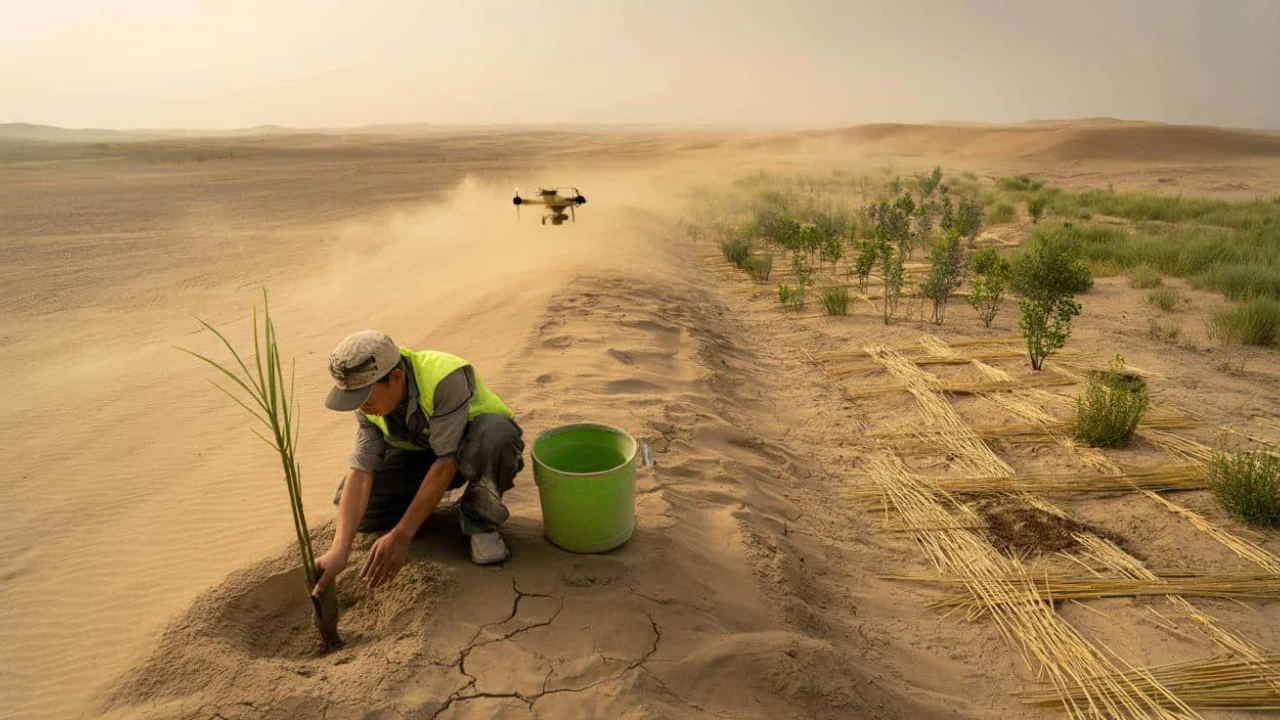
The main weapon in this fight is planting. In dry lands where nothing grows easily, workers dig holes in checkerboard patterns to help hold the sand. Then come the saplings: drought-tolerant trees like saxaul or Mongolian Scots pine. In some places, the dunes are first stabilized using straw nets that trap moisture and sand, preparing the ground for greenery.
Water is a make-or-break factor. In some parts, irrigation systems slowly feed the young trees just enough water to survive. In others, timing is key—planting happens only during short windows when there is moisture from snowmelt or brief rains. Recently, experts have moved toward using native plants with deeper roots and better drought resistance. These trees are more likely to survive in the long run and require less water and maintenance.
Behind the poetic image of a “green wall” lies a very practical toolkit
Beyond tree planting, policy also plays a big role. Large sections of land have been fenced off to allow natural recovery. This means limiting grazing or farming so that vegetation can return on its own. In some areas, herders have been asked to relocate so animals do not eat the regrowing plants. These changes are not easy, but they give land a chance to heal.
Other strategies include mixing tree types rather than planting monocultures. This helps create more stable ecosystems, where different plants work together to retain soil, resist pests, and survive harsh conditions. The shift is also practical—when communities plant trees that provide fruit or medicinal value, they are more likely to care for them. This makes the project not only an environmental effort but also an economic one.
Where the Great Green Wall works… and where it cracks
The truth is, not every tree survives. In fact, many early efforts failed. Some trees were planted in dry areas where they could not thrive. Others used too much water, causing problems for local communities. Sometimes, officials focused on fast-growing species that looked good on paper but did not last.
That is why recent projects focus more on planning and less on numbers. Choosing the right plant for the right place matters more than planting a million trees that die after two years. Letting nature take the lead—by simply protecting the land and letting it recover—has become a new and promising strategy.
What this giant experiment says about our future
The China Great Green Wall is not just about China. It is a test case for the rest of the world. Can we use nature to push back against the impacts of climate change? Can massive reforestation be done in a way that supports both people and ecosystems?
For countries dealing with desertification, from the Sahel to Central Asia, China’s experience is both inspiring and a cautionary tale. It shows that large-scale projects must be flexible, science-based, and rooted in the needs of local people. A forest that survives is not one that is forced—it is one that grows in harmony with the land.
FAQs
What is the China Great Green Wall project?
It is a large-scale ecological program designed to stop the spread of desert in northern China by planting billions of trees and restoring grasslands.
How effective is the project?
The project has helped reduce the frequency of sandstorms in some regions and increased vegetation cover, but success varies by location.
What kind of trees are planted in the green wall?
Common trees include poplar, pine, saxaul, and other drought-resistant native species suited to dry environments.
Does the project face any problems?
Yes, some challenges include water shortages, poor survival rates of non-native trees, and conflicts over land use.
Can other countries adopt this model?
Yes, but it needs to be adapted to local conditions. Every region must choose tree species and strategies that fit its environment and communities.