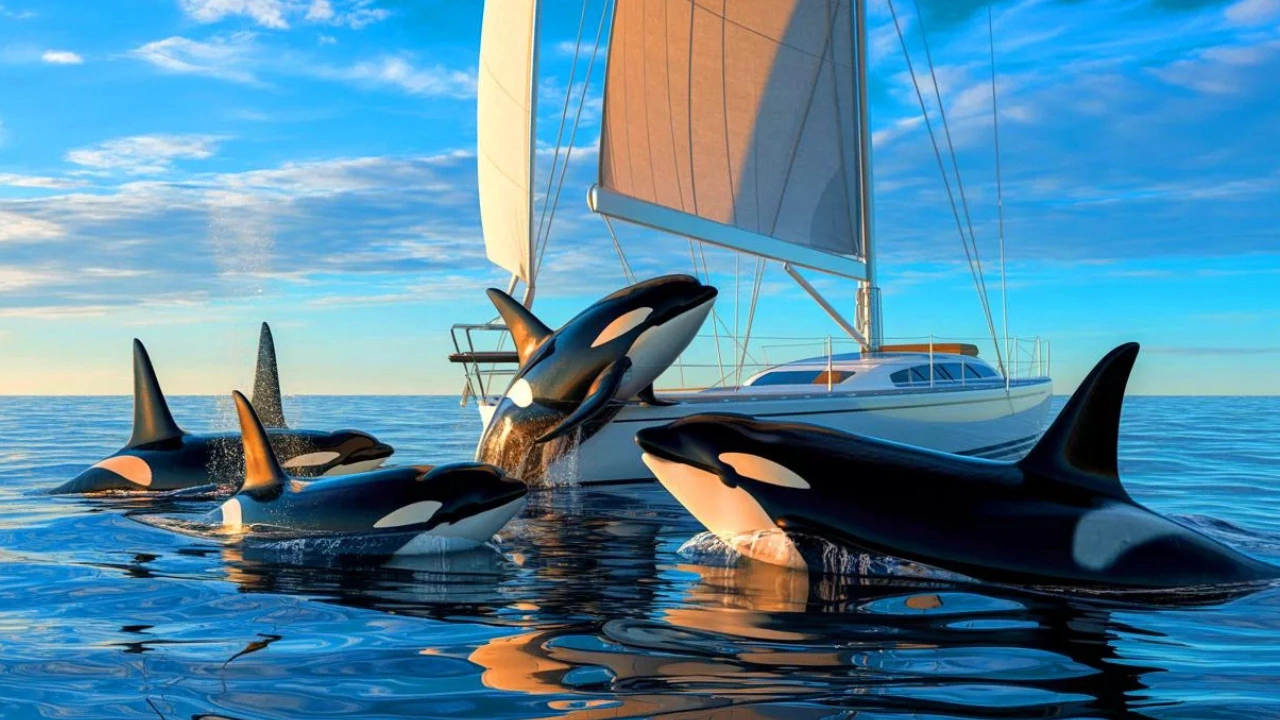
Let us talk about something that has caught the attention of both sailors and scientists alike: orca attacks on boats. What was once a rare, almost magical experience — spotting these majestic whales in the wild — has started to shift into something more intense, and at times, unnerving. Imagine being out on calm waters when suddenly your boat shudders from a massive hit below. That is not a freak wave — it is an orca, and it might not be alone.
In recent years, particularly along the coasts of Spain and Portugal, these orca attacks on boats have become more frequent and more focused. It is not just a matter of curiosity anymore. Rudders are being hit, boats are spinning out of control, and scientists are digging deep to understand what has changed in this relationship between humans and these incredibly smart marine mammals.
Orca Attacks on Boats: A Growing Pattern with Deeper Meaning
There is a clear uptick in reports of orca interactions that go beyond simple curiosity. These are not random encounters. The whales are often targeting the rudder, the most vulnerable part of a boat, and they are doing it repeatedly. What is even more interesting is that this behavior seems to be spreading within a specific population — the Iberian orcas. They are a small, critically endangered group, yet they are making big waves, quite literally.
Scientists are careful not to label this as aggression. Instead, they see it as a form of learned behavior, possibly passed along through their social groups. Whether it started with a single injured or curious whale or as a kind of orca “fad,” the effect is very real. Damaged vessels, shaken sailors, and a growing need for new safety guidelines. This shift in behavior is not only changing how we navigate certain waters but also how we understand and respect these intelligent creatures.
Overview Table: Key Details on Orca Interactions with Vessels
| Topic | Detail |
| Region most affected | Coastal waters near Spain, Portugal, and Morocco |
| Main target of attacks | Boat rudders, especially on sailboats |
| Population involved | Iberian orcas, a critically endangered group |
| First noted trend | Around 2020, off the Strait of Gibraltar |
| Number of reported incidents | Over 500 in just a few years, mostly involving small vessels |
| Time of day most common | Daytime, although night incidents are increasing |
| Type of vessels affected | Primarily sailboats with exposed rudders |
| Suggested response by sailors | Cut engine, avoid stern, stay calm, report the incident |
| Suspected causes | Learned behavior, curiosity, possible stress or injury |
| What not to do | Do not chase, feed, or try to engage with orcas near your boat |
From awe to anxiety: when orcas meet our boats
For generations, spotting orcas in the wild was something out of a nature lover’s dream. These creatures moved like shadows across the ocean, smooth and powerful, surfacing briefly before vanishing under the waves again. But now, that thrill of spotting an orca has shifted for many sailors into a moment of anxiety. Instead of admiration, there is tension. Will the orcas glide by, or will they make contact?
Stories are no longer just sailing forum chatter. They are real and repeated. Crews have described moments when their steering gave out, their boats were spun in circles, and they were left helpless as whales pushed and nudged their way around the hull. What was once a distant fascination now feels like a direct confrontation. And yet, most researchers urge us not to jump to fearful conclusions. These are highly intelligent animals responding to a changing world — one that humans have heavily shaped.
Behavior may be spreading within orca pods
One of the most intriguing parts of this story is how quickly this behavior has spread among orcas. Biologists tracking the Iberian orca population are seeing clear signs of a learned response. Orcas are deeply social animals. They teach each other hunting strategies, travel routes, and now, it seems, how to disable a sailboat’s steering.
Some believe it started with one orca that had a negative encounter with a vessel — perhaps a painful strike from a propeller. Others think it might just be curiosity taken to the next level. Either way, once one whale begins a new behavior, others often pick it up. This makes the situation unpredictable. What was initially dismissed as rare may now be a fast-growing trend that affects how we interact with wildlife at sea.
Human factors that may influence orca behavior
We cannot ignore the human side of the story. The ocean has become a noisy, busy place. Commercial ships, leisure yachts, fishing boats — all adding constant sound and traffic to an already stressed ecosystem. Some scientists suspect these conditions may be altering how orcas behave. Stress, food shortages, and even boredom could all be contributing factors.
Orcas seem to be more drawn to slower, quieter vessels. Sailboats, especially, are vulnerable. Their exposed rudders and low engine noise make them perfect targets for orcas exploring their surroundings. That means we need to think about how we navigate and when. Choosing faster routes, avoiding known orca hotspots during peak times, and staying alert can all reduce the chances of an encounter going wrong.
Safety guidelines for sailors in orca-prone waters
- Travel quickly through known orca zones
- Avoid sailing at times or locations where orca activity has been reported
- If orcas approach, cut your engine and remain calm
- Keep passengers away from the stern and rudder
- Do not engage with the whales — no feeding, tapping, or calling them closer
- Always report any interaction to local marine authorities
- Check maps for recent orca sightings before setting sail
- Avoid shallow areas where orcas may hunt
- Limit engine noise when possible, but do not travel too slowly
- Stay informed through sailing communities and marine research updates
What orcas might be telling us
Some researchers believe these repeated rudder strikes are not just random acts. They may be messages. The ocean is changing rapidly, and marine animals like orcas are reacting to pressures we have created. Overfishing has affected their food sources, and constant traffic has made their environment more chaotic. Maybe these encounters are just a form of communication — one that humans need to start listening to.
Labeling these intelligent beings as enemies or threats oversimplifies a complex issue. Instead, we need to approach it with curiosity and responsibility. The more we understand their behavior, the better equipped we will be to protect both our boats and the orcas themselves.
FAQs
Are orcas purposely attacking boats or just playing?
Scientists believe the behavior may be more about curiosity, stress, or learned behavior than aggression. It is not likely that orcas are trying to harm humans.
Why are most of these incidents happening near Spain and Portugal?
These waters are home to the Iberian orca population, a small group that appears to have developed this behavior over the last few years.
Is it still safe to sail in areas where orca encounters are common?
Yes, but extra caution is needed. Following updated safety guidelines can reduce risk significantly.
What should I do if orcas approach my boat?
Cut your engine, remain calm, move passengers away from the stern, and avoid any interaction. After the encounter, report it to the local marine authority.
Can this behavior spread to other orca populations around the world?
It is possible, especially since orcas are social animals. However, so far this behavior is mostly limited to a specific group near the Iberian coast.