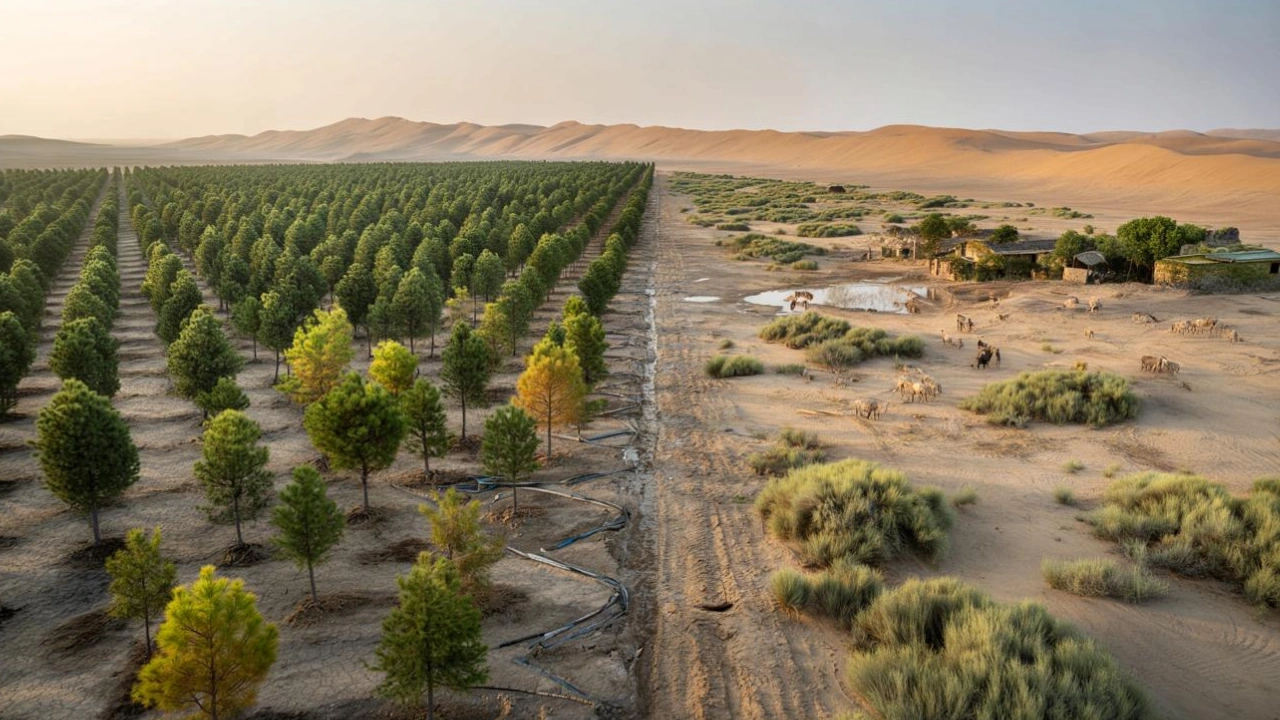
There is something remarkable happening on the edges of northern China. What was once lifeless desert is now slowly turning green. Dust storms that once painted the skies yellow are less frequent, and the sound of shovels digging into dry soil now echoes across regions that used to be choked by sand. This shift is not by accident. It is the result of China’s billion-tree planting effort, a reforestation project that has been unfolding for decades.
Since the 1990s, China’s billion-tree planting effort has been fighting back against creeping deserts that have threatened farmland, villages, and cities. This article breaks down how this massive campaign took shape, what it got right, where it went wrong, and how it is evolving to meet new environmental challenges. From tree survival rates to shifting weather patterns, we will look at the real impact of this ambitious green wall.
China’s billion-tree planting effort: How strategy is redefining the land
China’s billion-tree planting effort is not just about planting trees. It is about reshaping the land, restoring ecosystems, and building resilience against an increasingly unpredictable climate. The project began with a clear goal: to stop the desert from spreading further into habitable areas. Over time, the strategy matured from counting how many trees were planted to understanding which trees actually survive and why.
As the effort expanded in the 1990s, locals joined in by planting drought-resistant species and applying traditional knowledge. What used to be rigid, single-species rows have now become mixed plantings of native grasses, shrubs, and trees. This transition shows that long-term restoration works better than fast fixes. Today, the campaign focuses on soil health, water efficiency, and adapting to each region’s unique climate needs. It is not perfect, but it is working—and people are feeling the difference.
Overview Table
| Key Aspect | Details |
| Campaign Start | Late 1970s, major push in the 1990s |
| Main Focus | Slowing desert spread in northern China |
| Key Regions | Inner Mongolia, Maowusu Desert, Ningxia |
| Tree Types Used | Poplar, willow, tamarisk, drought-tolerant shrubs |
| Planting Techniques | Tree belts, crescent pits, mixed species strategies |
| Local Involvement | Farmers, schoolchildren, soldiers engaged in planting |
| Results Observed | Reduced dust storms, improved vegetation cover, soil stabilization |
| Current Challenges | Low survival rates in early years, climate change, water scarcity |
| Evolving Focus | From tree count to ecological restoration and native planting |
| Long-Term Vision | Sustainable landscapes using diverse vegetation and smart water use |
How a green wall began to slow a moving desert
Walk through villages near the Maowusu Desert, and the evidence is clear. In the 1990s, windblown sand buried roads and farmland. Dust storms entered homes. Now, rows of trees line the desert’s edge, offering both shade and stability. Local stories describe how older generations remember tasting sand in the air during spring. Today, while dust storms still happen, they are weaker and fewer.
What made the change possible? Roots. Even shallow ones can hold the soil in place and reduce wind erosion. Trees act as windbreaks. Their leaves trap moisture and block blowing sand. Researchers have found that since the 1990s, satellite images show a decline in net desert expansion. That shift is not minor. It means life is returning to land that was previously lost to the desert.
What worked, what failed, and what’s quietly changing
Not all parts of China’s billion-tree planting effort have gone smoothly. In the early stages, many trees were planted quickly with little thought about local conditions. Some regions used water-heavy species that died within a year. Survival rates were poor. Dead trunks now stand as reminders of those early mistakes.
However, valuable lessons emerged. Instead of focusing only on numbers, local efforts began to shift toward species that could survive the dry conditions. Some areas experimented with crescent-shaped pits that collect rainfall. Others started mixing shrubs and grasses with trees. These practical adjustments made a huge difference. Now, policies stress local adaptation and long-term survival over planting speed.
Lessons from the ground
- Diversity leads to success: Planting only one species might look good from a satellite, but mixed planting with native shrubs and grasses leads to better soil health and tree survival.
- Simple techniques work best: Local farmers use small tricks like water-trapping pits or leaving gaps for natural vegetation, which help saplings survive in dry climates.
These on-the-ground solutions reflect a growing understanding: fighting the desert takes patience. Communities that work with nature instead of against it are seeing better, lasting results.
From tree count to ecosystem restoration
In the past, success was measured in millions of trees planted. Today, the question is different: how many of those trees are still alive? The answer has changed the direction of the campaign. Now, the focus is on full ecosystem restoration. That means restoring not just trees, but also the grasses, insects, animals, and water systems that make a landscape thrive.
Forests are no longer planted in straight lines. Instead, mosaics of mixed vegetation are now preferred. Some regions are even giving land back to natural grasslands. Scientists have advised against draining rivers or aquifers for tree planting, emphasizing the importance of protecting water. The result is more resilient landscapes that can handle climate pressure.
The messy future of fighting sand with green
Even with progress, China’s billion-tree planting effort still faces an uncertain future. Climate models predict hotter, drier years ahead for northern China. That means the campaign will need to keep evolving. In some areas, trees may need to be replaced with native grasses or hardy shrubs that can survive with minimal water.
Still, hope remains. Children now grow up surrounded by greenery their grandparents never saw. That alone marks a shift in how people live with their environment. The sands have not disappeared, but they are no longer marching forward. For now, the balance has been changed by millions of small hands working together, year after year.
FAQs
Is the desert still growing in China?
In many northern regions, desert expansion has slowed or reversed, thanks to successful reforestation and land restoration efforts.
Did all trees planted under this effort survive?
No. Many early plantations failed due to poor species selection and lack of water. Later efforts improved survival by using local, drought-resistant species.
Are dust storms really less common now?
Yes. Data shows that dust storms have decreased in frequency and strength, especially in places where tree belts have matured.
Is planting trees enough to stop desertification?
Not alone. Real progress comes from a mix of trees, grasses, shrubs, water conservation, and land-use changes.
Can other countries learn from this model?
Absolutely. While every region is different, the lessons from China’s billion-tree planting effort—like using native plants and planning for long-term survival—are useful worldwide.